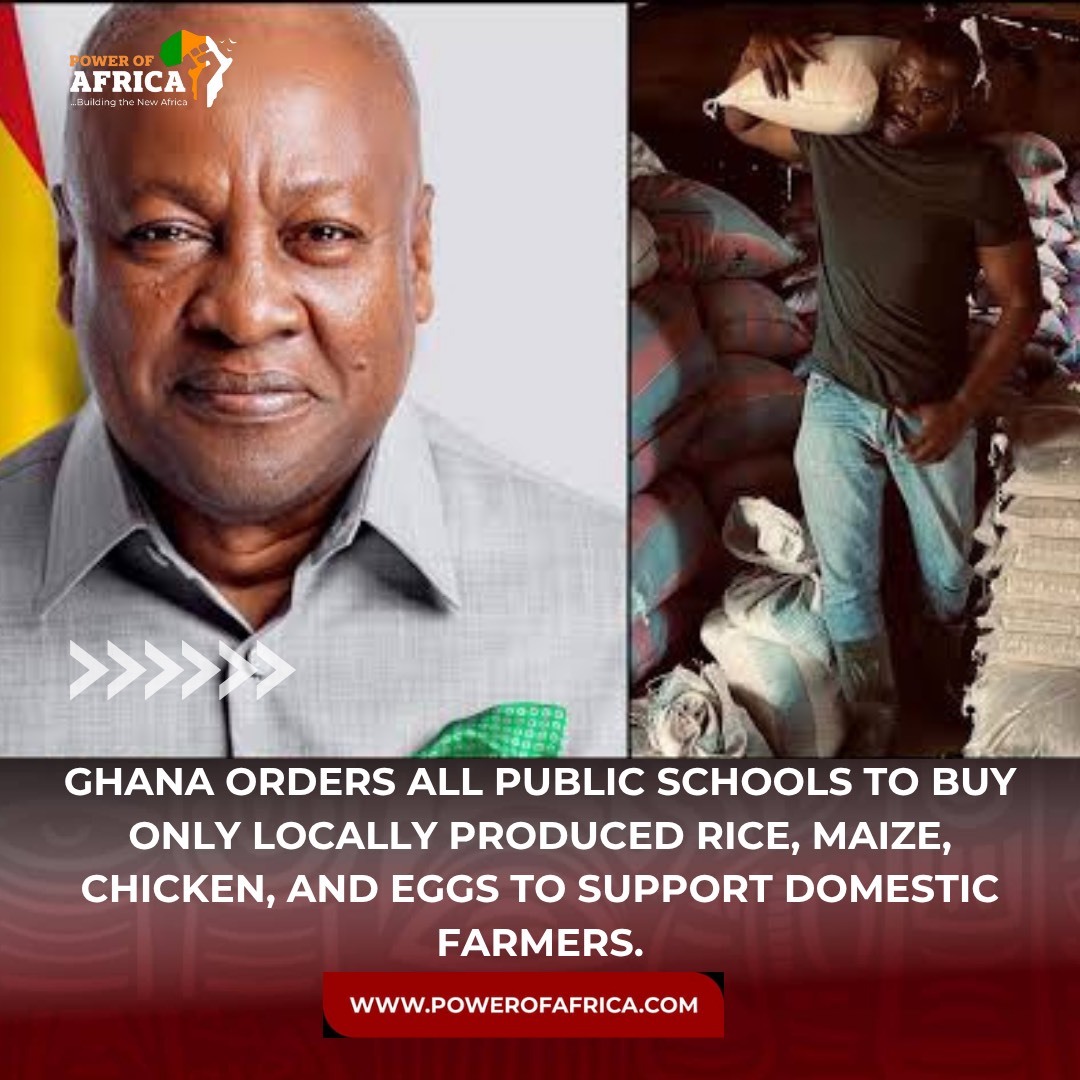
The Government of Ghana has announced a major policy shift requiring all public schools to purchase only locally produced rice, maize, chicken, and eggs as part of a nationwide effort to strengthen domestic agriculture and support local farmers.
The directive, announced during the presentation of the 2026 national budget, is aimed at reducing dependence on imported food items and ensuring a guaranteed market for Ghanaian farmers who have recently struggled with price fluctuations and gluts in key commodities.
The Ministry of Education, the School Feeding Programme, the Free Secondary Education Secretariat, and the National Food Buffer Stock Company have all been tasked with enforcing the new procurement rule. According to government officials, schools will now be required to source their staple foods from Ghanaian producers and distributors across the country.
To bolster this transition, the government is injecting an additional GH₵200 million into the National Food Buffer Stock Company to buy, store, and distribute surplus rice, maize, and eggs from local farmers. This support is expected to stabilize farmgate prices, prevent food waste, and guarantee consistent supplies for schools.
The directive, announced during the presentation of the 2026 national budget, is aimed at reducing dependence on imported food items and ensuring a guaranteed market for Ghanaian farmers who have recently struggled with price fluctuations and gluts in key commodities.
The Ministry of Education, the School Feeding Programme, the Free Secondary Education Secretariat, and the National Food Buffer Stock Company have all been tasked with enforcing the new procurement rule. According to government officials, schools will now be required to source their staple foods from Ghanaian producers and distributors across the country.
To bolster this transition, the government is injecting an additional GH₵200 million into the National Food Buffer Stock Company to buy, store, and distribute surplus rice, maize, and eggs from local farmers. This support is expected to stabilize farmgate prices, prevent food waste, and guarantee consistent supplies for schools.

Agriculture Minister Eric Opoku noted that the initiative would protect farmers from losses caused by overproduction and would ensure that locally grown food reaches millions of children daily. He emphasized that the directive also supports youth farmers, poultry producers, and cooperatives that rely heavily on the school food market.
The policy is seen as part of Ghana’s broader “produce, buy, and eat local” agenda aimed at boosting the agricultural value chain, creating jobs, strengthening food security, and retaining more of the country’s food expenditure within the local economy.
Economists and agricultural groups have praised the initiative as a transformative step that could significantly expand domestic agribusiness while reducing the country’s food import bill. However, some stakeholders stress the need for improved storage, transportation, and quality control systems to ensure consistent supply to schools nationwide.
The new directive is expected to take effect immediately across all public basic and secondary schools.
The policy is seen as part of Ghana’s broader “produce, buy, and eat local” agenda aimed at boosting the agricultural value chain, creating jobs, strengthening food security, and retaining more of the country’s food expenditure within the local economy.
Economists and agricultural groups have praised the initiative as a transformative step that could significantly expand domestic agribusiness while reducing the country’s food import bill. However, some stakeholders stress the need for improved storage, transportation, and quality control systems to ensure consistent supply to schools nationwide.
The new directive is expected to take effect immediately across all public basic and secondary schools.
